How the Hey referral link works: on-chain posts on Lens
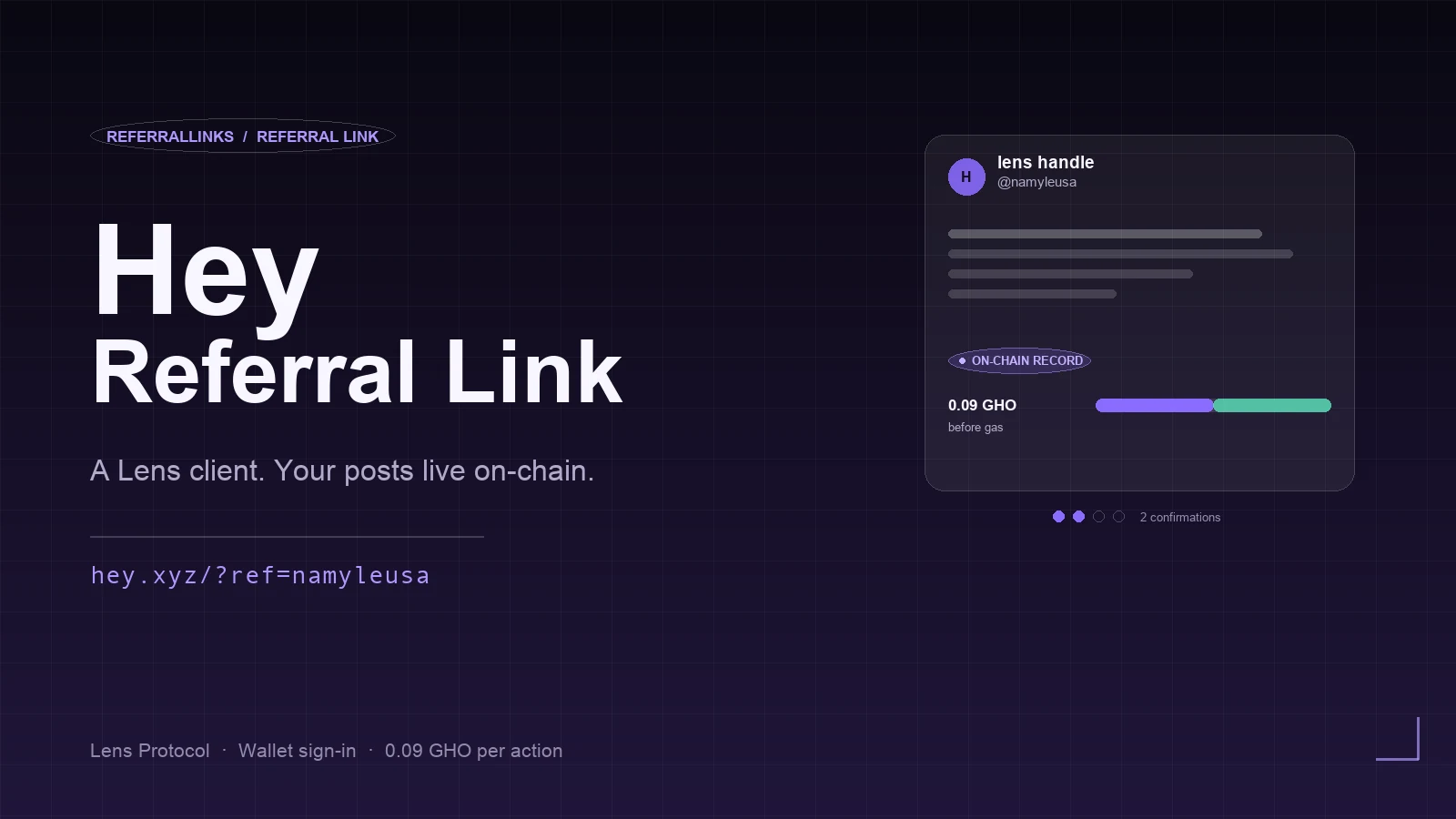
Hey is a Lens client, so your posts are on-chain records and every action costs 0.09 GHO plus gas. See what the referral link does, what posting really costs and why confirmations come in pairs.
Save on your first trade
See the verified code, the current terms and the risk notes for this platform.
Hey (hey.xyz) is a client for the Lens Protocol, a decentralized social graph that lives on public blockchain networks rather than in one company's database. That changes what a referral link can even mean: Hey does not publish a referral program with a discount, so this guide covers what the docs do document (posting, on-chain records, GHO fees and wallet confirmations) and what you should check before you start. You can compare it with every other deal on our crypto referral codes page.
Quick answer
The ReferralLinks link is https://hey.xyz/?ref=namyleusa, and the handle namyleusa travels in the query string. Hey's own documentation describes on-chain posting and a flat 0.09 GHO Social Payment per publishing action, plus gas. It does not describe a referral reward, so treat the link as attribution rather than a published discount, and confirm anything you are promised inside the app.
What is Hey, in plain words?
Hey is a social app that reads, creates and interacts with content on Lens: posts, reposts, quote posts and comments. The difference from a normal social network is where the data lives. Posts are anchored on-chain and stored through protocol-related infrastructure, and your account is a Lens account controlled by a wallet.
That design has two visible consequences. First, you sign in with an EVM-compatible wallet and Hey never holds your keys or custody of your funds. Second, publishing usually involves more than one transaction, because the app may create or update on-chain records, attach protocol modules and pay a protocol fee in the network's native token.
How the Hey referral link works
Open https://hey.xyz/?ref=namyleusa. The ref parameter identifies the referring handle, so the app can record it when you create or connect your Lens account through that link. Sign in with the wallet that will own the account, and keep that wallet available for the rest of onboarding.
One honest caveat: Lens handles are portable. If you already own a Lens account you can use it in any Lens client, including Hey, and a referral link cannot retroactively claim an account you already control. Referral attribution only makes sense at the point where a new account is created through the link.
What the referral actually gives you
Unlike the exchanges on this site, Hey's documentation does not publish a referral percentage, a reward asset or a qualifying threshold. Two very different things hide behind the word referral: attribution, which records who brought a new user, and reward, which is what that attribution pays. Only attribution is visible here.
So the useful question is not "how much do I get", but "what will this app cost me once I am inside". Hey answers that one precisely, and the answer is not zero.
What posting costs: the 0.09 GHO Social Payment
Hey runs a Social Payment on publishing actions. Each action carries a flat 0.09 native GHO, before gas, split on-chain between the protocol treasury and, for some actions, the author of the post you interact with.
In the global feed: a new post sends the full 0.09 GHO to the protocol treasury. A comment, repost or quote post sends 0.045 to the treasury and 0.045 to the root post author.
Group feeds share differently. A new post in a group sends 0.045 to the treasury and 0.045 to the group owner. A comment, repost or quote post there sends 0.03 to the treasury, 0.03 to the root post author and 0.03 to the group owner.
Self-interactions on your own root post still cost 0.09 GHO, but the author share goes to the treasury. That closes the obvious loop of commenting on yourself to farm your own payout.
Gas is separate, and so are failures
The amounts above exclude network gas. You pay gas for the publication transaction and again for each fee step, so a single action can mean several small charges. Hey is explicit that gas follows network and market conditions, not the app, and that you may incur costs even when an action later fails for reasons outside Hey's control.
Practically: a failed publish is not always free. Budget for gas on the steps you attempt, not only the ones that succeed.
Why your wallet asks more than once
Some flows need several separate confirmations. One step may register or attach a protocol fee module to a publication; another may pay the associated network fee. Each is a distinct transaction with its own prompt, which is why Hey asks you to keep the tab open until the flow completes.
Read each prompt rather than approving on reflex. A blind approval on a social app is still a signature that can move value, and wallet-draining sites rely on exactly that habit. If a prompt shows an amount or a contract you do not recognise, close it and start again from hey.xyz typed into the address bar.
On-chain means permanent
Hey's documentation is blunt: assume successful on-chain steps are permanent and cannot be undone through the app. Text and media are typically uploaded to decentralized storage through the Lens stack, and what you can edit or delete in the product may still leave traces on-chain or in indexes.
That is the real cost of a decentralized social graph. There is no support desk that can quietly remove a post from the record. Think before you publish, and do not treat a delete button as a guarantee.
Creators get paid, but only on engagement
Social Payment is the flip side of the fee: when someone comments, reposts or quotes your post, part of what they pay lands in your wallet when their transaction settles. There is no claim step, and replies deeper in the thread still pay the original post author rather than the last person who spoke.
Likes stay free. Paid actions are what fund creators, and the rules are the same for everyone: no follower minimums and no special tiers. Hey also runs a creator awards leaderboard for the current period, which is worth a look before you assume engagement is easy to earn.
How to start without wasting money
Use hey.xyz typed into the address bar, or the link on this page, and check the domain before you connect a wallet. Sign in with a wallet you control, confirm the account is the one you meant, and start with one post to see how the confirmations and the 0.09 GHO charge actually appear in your history.
Do the sums before you commit to a posting habit. Ten comments a day at 0.09 GHO is roughly 0.9 GHO daily before gas, which is fine for someone building an audience and expensive for someone testing the waters. Nobody needs your seed phrase to show you a social app, in any client.
Frequently asked questions
What is the Hey referral link?
The ReferralLinks link is https://hey.xyz/?ref=namyleusa. The ref parameter identifies the referring handle when you create or connect an account through it. Hey does not publish referral reward terms in its documentation.
Does Hey hold my funds or my keys?
No. You sign in with an EVM-compatible wallet that controls your Lens account, and Hey states it has no custody of your private keys or the funds in your wallet. You are responsible for every approval your wallet shows.
How much does posting on Hey cost?
A flat 0.09 GHO Social Payment per publishing action, before gas. Comments, reposts and quotes split 0.045 to the treasury and 0.045 to the root post author in the global feed; group feeds also pay the group owner.
Why does my wallet ask for two confirmations?
Because the flow has more than one on-chain step, for example attaching a fee module to a publication and then paying the network fee. Each step is a separate transaction, so keep the tab open and read every prompt.
Can I delete a post I published on Hey?
The app may let you edit or delete things in its interface, but Hey tells users to assume successful on-chain steps are permanent. Content can also persist in indexes and decentralized storage even after you remove it from the product.
Related referral codes
Compare every verified deal on our crypto referral codes page, or read the fomo referral link and Metric referral link guides next.