What xStocks are, and what its points link does not tell you
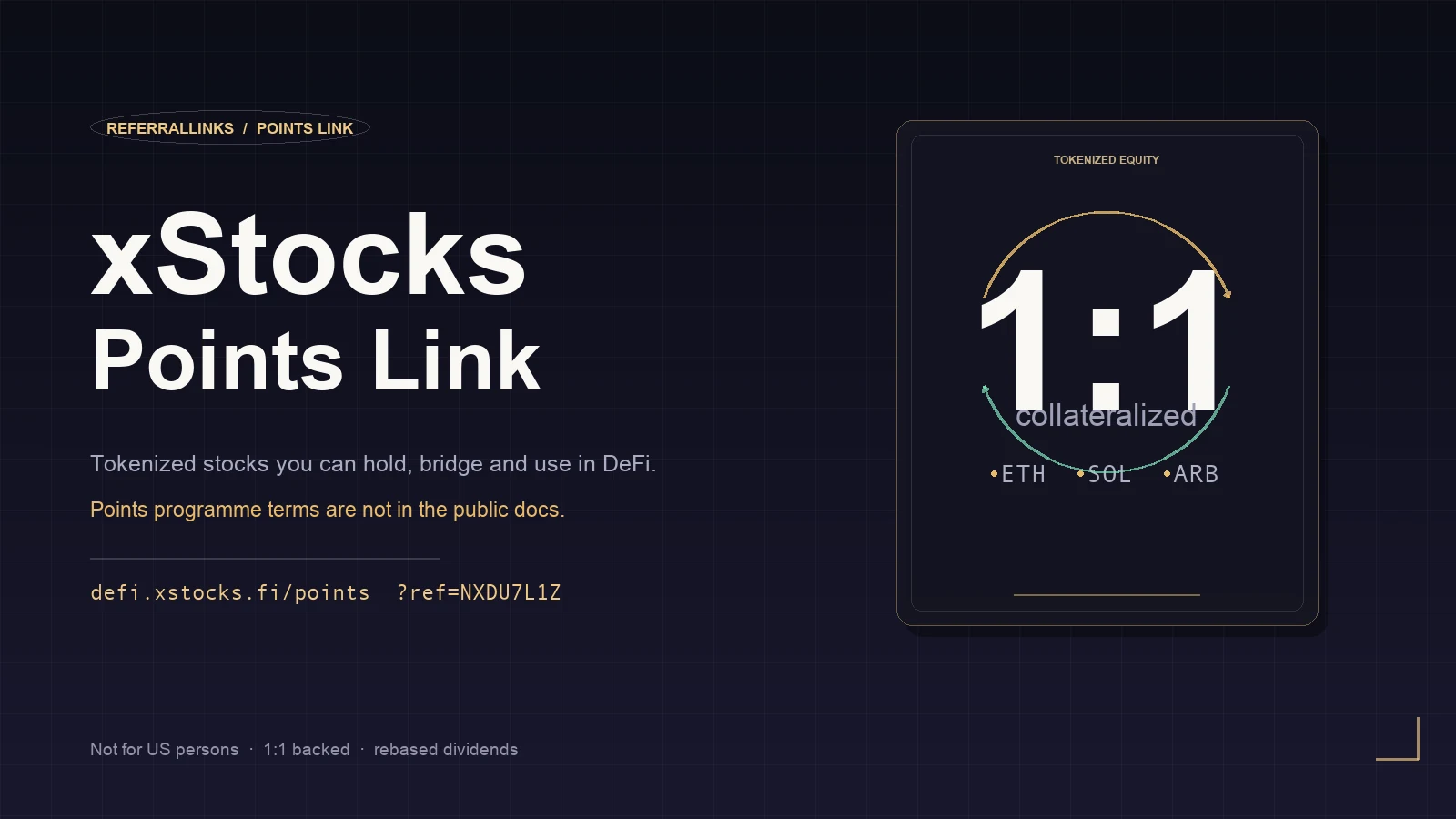
xStocks are tokenized stocks backed 1:1 and rebased for dividends. Here is how they work, who cannot use them, and why the points programme behind its referral link has no published terms.
Save on your first trade
See the verified code, the current terms and the risk notes for this platform.
xStocks (xstocks.fi, DeFi portal at defi.xstocks.fi) are tokenized stocks: blockchain tokens that represent the economic value of a specific share or ETF held 1:1 in custody by a regulated institution. They trade on public chains, settle in seconds, sit in self-custody and can be used in DeFi. The reason this guide is longer on mechanics than on rewards is simple: xStocks publishes detailed documentation about the product and almost nothing about the points programme behind its referral link. You can compare it with every other deal on our crypto referral codes page.
Quick answer
The ReferralLinks link is https://defi.xstocks.fi/points?ref=NXDU7L1Z, and the code is NXDU7L1Z. It points at the xStocks DeFi portal's points page, so the code is the referral identifier for that programme.
What the programme pays is not in the public documentation. There is no published reward rate, no qualification threshold and no payout schedule that we could verify from the docs. Treat the link as an identifier and check the points page itself for terms, rather than trusting a percentage quoted anywhere else.
What is an xStock, in plain words?
An xStock is a tracker certificate, not a share. Each token represents the economic value of one underlying stock or ETF, fully collateralized 1:1, with the underlying held in segregated custody by a regulated institution. Holding it gives you price exposure. It does not give you shareholder rights such as voting.
The structure behind that is the part worth understanding before you size a position. The issuer uses a bankruptcy-remote SPV, keeps collateral segregated asset by asset with no commingling, and puts a three-party Account Control Agreement in place with an independent security agent that has visibility over the collateral. Proof of reserves is published through the DeFi portal, and the contracts are audited.
That is a stronger structure than most tokenized-asset products, and it is still not a bank deposit. If the issuer defaults, the security agent can take control of the collateral accounts and distribute proceeds under the prospectus terms. That is a legal process, not an instant redemption.
Dividends and splits: rebasing, not a payout
Corporate actions are handled by rebasing rather than by sending you a separate payment. Dividends received on the underlying equity are reinvested into additional units of the same asset, net of applicable taxes. A stock split multiplies your balance, a reverse split divides it, and you do not have to do anything.
The implementation differs by chain, and this matters if you are reconciling balances. On EVM chains the token contract adjusts balances automatically, so your wallet shows a new number. On Solana the raw onchain balance stays constant and a multiplier is applied for display through the Scaled UI extension, so a block explorer and your wallet can disagree until the interface applies the multiplier. Neither case is a bug.
The practical consequence: do not treat a static balance snapshot as your holdings on Solana, and do not be surprised when an EVM balance changes overnight after a dividend.
Two markets, two sets of rules
The primary market is where tokens are issued and redeemed with the issuer. It requires KYC/AML onboarding, runs 24/5 alongside US equity market hours, and has a $5,000 minimum transaction size. Issuance and redemption work with stablecoins, or in kind with the underlying equity through the xPort flow.
The secondary market is everything else. Once issued, the tokens trade freely on supported exchanges and DeFi venues, potentially 24/7 depending on the platform, with no interaction with the issuer and no minimum imposed by the issuer.
So the honest picture for a retail user is that you almost certainly trade on the secondary market, where price comes from supply and demand on that venue rather than from the issuer. The issuer states it does not control secondary pricing. That means a thin pool can trade at a noticeable premium or discount to the underlying share, especially at weekends when the equity market is closed and the token is not.
Multi-chain, and what bridging does not change
xStocks are issued natively on Ethereum, Solana, Arbitrum, Mantle, TON, Ink and other EVM-compatible networks, and a cross-chain bridge moves them between supported chains. Bridging changes the network the token sits on, not the product, the collateral or your economic exposure.
It does add the usual bridge risk to the usual custody risk. Each additional chain is another contract deployment and another set of liquidity conditions, which is why the same xStock can trade at slightly different prices on different venues.
DeFi composability is the real differentiator
A tokenized stock that can only be held is a novelty. xStocks are designed to be used: as collateral in lending markets, in liquidity pools, and inside structured products, with the issuer running an alliance of exchanges, chains and DeFi protocols to standardize integration.
That is also where the risk concentrates. Using a tokenized equity as loan collateral means a liquidation engine can sell it during hours when the underlying market is shut, against thin liquidity, at whatever the pool will pay. The token being 1:1 backed does not protect you from a bad liquidation price.
Who cannot use this
xStocks are not intended for distribution in the United States, to any US person, or in any other prohibited jurisdiction, and the issuer directs readers to assets.backed.fi/legal-documentation for the full restricted list. That is an eligibility rule, not a suggestion, and a referral link does not change it.
The same documentation is explicit that the site is informational and is not an offer or solicitation to buy or sell any financial product, and that xStocks does not provide investment advice. Nothing on this page is advice either.
What the points link actually gets you
The link goes to the points page on the DeFi portal. That is where any programme terms, eligibility rules and reward details would live, and it is where you should look, because the product documentation does not describe them at all.
Two things are worth being careful about. First, a points programme is not the same thing as a fee discount: points usually convert into something later, on terms the operator sets and can change, and their value can be zero. Second, a code in a URL is an identifier, so anyone can hand out a similar-looking link and quietly redirect your activity. Type defi.xstocks.fi yourself and check the ref parameter character by character.
How to start
Open the link on this page, or type defi.xstocks.fi into the address bar and confirm the ref reads NXDU7L1Z. Connect a wallet on a chain where the xStock you want actually exists, and check the venue's price against the underlying share before you buy, particularly at weekends.
If you want direct issuance or redemption, expect onboarding and the $5,000 minimum, and treat 24/5 as the operating window. If you only want exposure, the secondary market is simpler, cheaper and available around the clock, with the trade-off that price is whatever that pool says it is.
Frequently asked questions
What is the xStocks referral code?
The ReferralLinks code is NXDU7L1Z, built into the link at https://defi.xstocks.fi/points?ref=NXDU7L1Z. It points at the points page of the xStocks DeFi portal, and the programme terms are published there rather than in the product documentation.
What do I earn from the xStocks points link?
The public documentation does not say. There is no published reward rate, threshold or payout schedule that we could verify, so treat the link as an identifier and read the points page for the actual terms.
What do I own when I hold an xStock?
A tracker certificate that gives you economic exposure to one underlying stock or ETF, fully collateralized 1:1 and held on a public blockchain. It does not carry shareholder rights such as voting.
How are dividends and splits handled?
Through an onchain rebasing mechanism. Dividends are reinvested into additional units net of applicable taxes, and splits or reverse splits adjust balances proportionally. On EVM chains the contract updates balances, while on Solana the raw balance stays constant and a multiplier is applied for display.
Are xStocks available in the United States?
No. xStocks are not intended for distribution in the United States, to any US person, or in any other prohibited jurisdiction, and the issuer maintains a restricted list at assets.backed.fi/legal-documentation.
Related referral codes
Compare every verified deal on our crypto referral codes page, or read the Lighter referral code and Entropy referral code guides next.