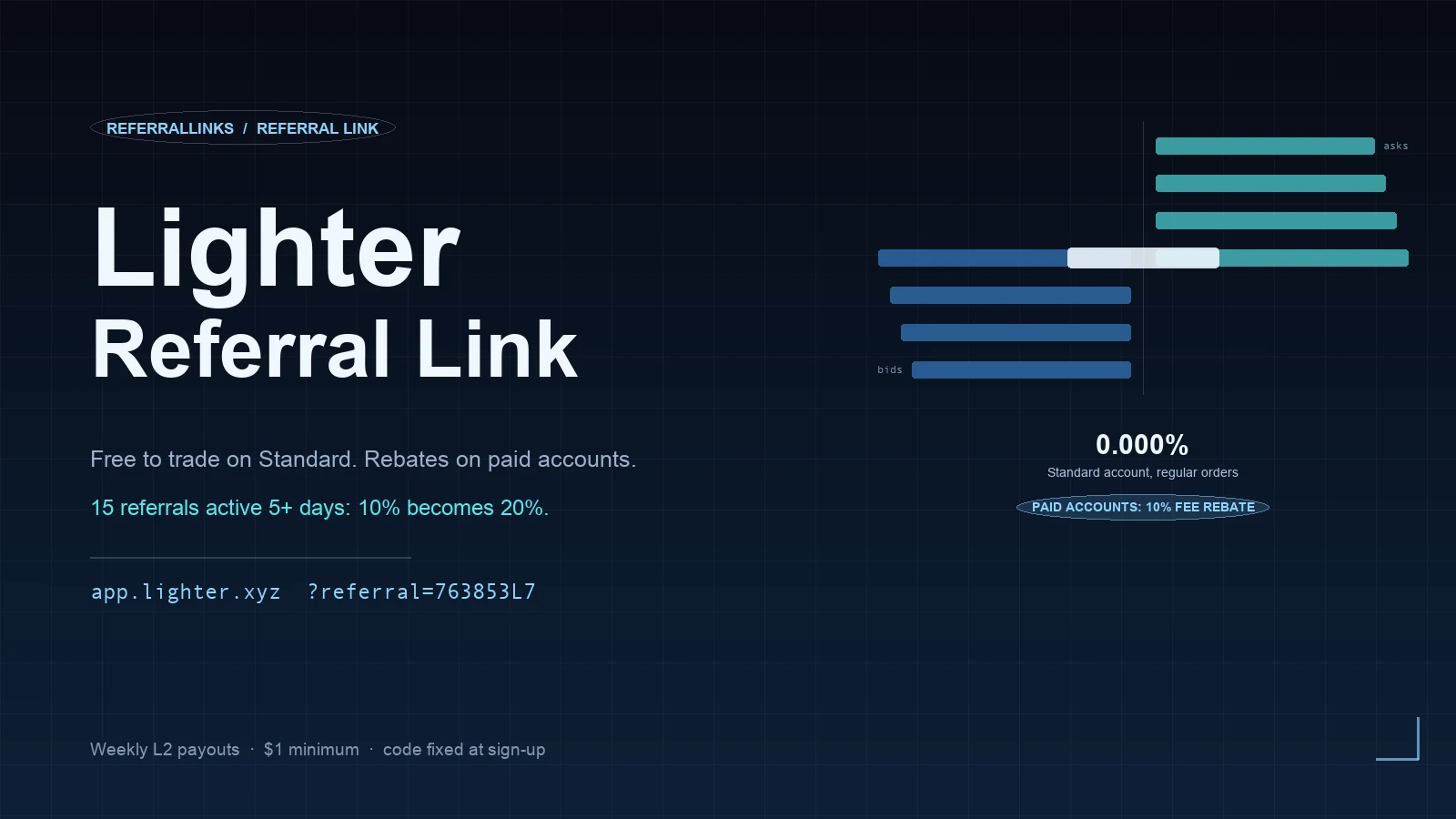
Most comparisons of Lighter stop at “Standard is free, Premium is faster”, which is true and useless. The decision is a number: what the paid account costs per million dollars of volume, and what the extra speed has to be worth for that cost to disappear.
Everything below is out of the published fee schedule, so you can redo the arithmetic yourself.
What the two accounts actually change
Lighter runs three account types. Standard is the default and is free on regular perpetual and spot orders. Premium (also called Advanced in the docs) is the opt-in paid tier, and Plus is a flat 0.5 bp tier aimed at desks that need high rate limits and up to sixteen sub-accounts.
The comparison that matters for almost everyone is Standard against Premium.
| Feature | Standard | Premium / Advanced |
|---|---|---|
| Regular perp & spot | 0 maker / 0 taker | 0.0040% maker / 0.0280% taker |
| Advanced orders & RFQ | 1 bp (0.01%) | Charged on the same card |
| Taker / cancel latency | ~300 ms | ~140 ms |
| LIT staking discount | Not available | Up to 30% off both sides |
| Sub-accounts | Up to 4 | Not documented on the public fee page |
Rates are the published zero-stake figures and assume no LIT is staked. Latency is Lighter’s own stated target, not a measured median.
Two rows do all the work. The first row is the fee you pay per fill, and the third row is how long the exchange takes to confirm it. Every argument about which account to open is really an argument about the exchange rate between those two numbers.
Premium is a latency purchase, not a discount
Read the fee column literally. A Premium taker fill costs 0.0280%, which is 2.8 basis points. A Standard account doing the same trade as a regular order costs nothing, and even the advanced-order rate on Standard, 1 bp, is less than half. Premium is not cheaper at any volume. It is not designed to be.
That inverts the usual advice. A guide that says “upgrade for lower fees” has the comparison backwards: you upgrade to pay fees, in exchange for a taker and cancel path that is roughly 160 ms quicker.
For a market maker quoting both sides of the book, or a strategy whose entire edge is being first, that trade is obvious. For a directional trader holding a position for days, the 160 ms is worth nothing and the fee is pure cost.
Where the staking ladder turns
Staking LIT reduces Premium fees, and the ladder is steep at the top: 500,000 LIT removes 30% of the fee, which takes the taker charge from 0.0280% to 0.0196%. Worth reading twice, because it is the only published mechanism that moves the Premium number.
| LIT staked | Discount | Maker | Taker |
|---|---|---|---|
| 0 | None | 0.0040% | 0.0280% |
| 1,000 | 2.5% | 0.0039% | 0.0273% |
| 10,000 | 10% | 0.0036% | 0.0252% |
| 100,000 | 20% | 0.0032% | 0.0224% |
| 500,000 | 30% | 0.0028% | 0.0196% |
Maker and taker figures are the published zero-stake rates less the published stake discount. Cancel and Post Only placement carry no extra latency on this account type.
Even the top of the ladder does not close the gap. At 500,000 LIT a Premium taker pays 1.96 bp, still almost double the 1 bp that a Standard account pays for advanced orders, and still above the zero it pays for regular ones. Staking buys a smaller gap. It never turns Premium into the cheap account.
The break-even point, in dollars
Percentages hide the decision, so here is the same schedule as money. The last column is what the ReferralLinks rebate returns on Premium fees at Bronze, 10% of what the referred trader paid.
| Monthly taker volume | Standard, regular | Standard, advanced | Premium | Premium at 500k LIT | 10% rebate |
|---|---|---|---|---|---|
| $10,000 | $0 | $1.00 | $2.80 | $1.96 | $0.28 |
| $100,000 | $0 | $10 | $28 | $19.60 | $2.80 |
| $1,000,000 | $0 | $100 | $280 | $196 | $28 |
| $5,000,000 | $0 | $500 | $1,400 | $980 | $140 |
Premium column is 0.0280% and the 500k-LIT column is 0.0196% of the volume. Rebate is 10% of the Premium figure, before any Silver upgrade.
The honest break-even is not a volume, it is a fill. A $10,000 taker round trip is two fills, so it moves $20,000 of volume: at that size Premium costs $3.60 more than a Standard account using advanced orders ($5.60 against $2.00), not $2.80.
If the 160 ms you buy prevents one adverse fill worth more than $3.60 a day, Premium is cheaper in practice. If it does not, you are paying a subscription for speed you are not using.
Who should stay on Standard
Stay on Standard if any of these is true. You are testing the venue and want to see whether the order flow, the charts and the settlement work before you commit capital. You trade directionally over hours or days, where 160 ms is noise.
You place fewer than a few hundred orders a day, so rate limits never bind. Or you want four sub-accounts and nothing more.
The important part is that Standard is not a crippled trial. You get the same order book, the same matching and the same advanced order types; you simply pay 1 bp when you use the advanced ones and nothing when you do not.
The zero on regular perp and spot orders is the actual product, and it is unusual enough to be worth saying plainly.
Who should pay for Premium
Pay for Premium when the fill is the edge rather than the position. Market makers quoting both sides need the shorter cancel path more than they need 2.8 bp, because a stale quote that gets picked off costs more than the fee on every trade that filled properly.
The same goes for basis trades and anything else competing for queue position on a venue that publishes sub-second matching.
If you are in that group, the staking ladder becomes a rational purchase rather than a token play: the fee you already decided to pay gets 30% smaller, and the capital is doing something measurable.
If you are not in that group, no amount of staking makes the account pay for itself, because the base fee is not the problem. The latency is the only thing you are buying, and you do not need it.
What the rebate does on each account
A rebate is a share of a fee, so it only exists where a fee exists. On Standard, regular perpetual and spot orders generate no fee and therefore no rebate, whatever your volume. On Standard advanced orders, the 1 bp charge is rebateable, which returns 0.1 bp to you.
On Premium, the 2.8 bp taker charge returns 0.28 bp, or 0.196 bp with 500,000 LIT staked. The referrer’s side of the same fees is 10% at Bronze and 20% at Silver.
The code, the Silver requirements and the payout schedule are not repeated here. They live on the Lighter referral code page. This one is about the account you open after you get there.
Frequently asked questions
Is a Standard account really free?
On regular perpetual and spot orders, yes: zero maker and zero taker fee. It is not free on everything. TWAP and other advanced order types and RFQ cost 1 bp on Standard, and binary options have their own fee schedule.
Do I need Premium to use a referral code?
No. A referral code attaches at sign-up whatever account type you pick, and the attribution is permanent. On Standard regular orders there is simply no fee for a rebate to discount, so the code earns you nothing until you generate a fee through advanced orders or a paid account.
Does staking LIT make Premium cheaper than Standard?
No. The maximum published discount is 30%, which takes the Premium taker fee to 0.0196%. Standard charges 1 bp on advanced orders and nothing on regular ones, so Premium stays the more expensive account at every stake level.
Is Premium worth it for a retail trader?
Only if 160 ms changes your fills. For a position held for hours or days the latency premium buys nothing, and the 2.8 bp taker fee is a straight cost. A retail trader with no latency-sensitive strategy is better served by Standard.
How much does the rebate return at $1m of monthly volume?
On Premium taker volume, about $28 a month at Bronze, because the fee is $280 and the rebate is 10%. On Standard regular orders, nothing, because the fee is zero. The table above has the rest of the range.
Before you commit
These answers do not depend on the current rate, so they stay true when the numbers above them move.
How to check that the Lighter code actually applied
Check on the platform, not on a code list. Open app.lighter.xyz from its own domain, start the sign-up (or the first deposit) and read the confirmation screen before you approve anything.
A referral that registered shows up as one of three things: a reduced fee in the order preview, a rebate line in the account, or a visible referral tag next to your address.
If none of the three is there, stop and reopen the link from this page instead of signing up and looking for a code field afterwards.
Almost every program in this list attaches the referral at registration only; a code typed later, or a page refreshed later, cannot retroactively claim an account that was created without one. This site re-tests each flow by hand and prints the date in the sidebar.
How we test codes describes what that involves.
What happens if the Lighter program changes or ends
Two different things end at two different times. The terms you signed up under usually keep applying to your account while the program runs, and the platform can change those terms with notice, so a rate you earned last month is not a rate you are owed next month.
When a program ends, the code field stops accepting new codes and new sign-ups stop being attributed; existing balances revert to the standard rate on the platform’s own schedule.
Commission already credited is the platform’s obligation to the person who referred you, not something this site can recover or guarantee. If a page here is out of date, it is because the change has not been re-checked yet, not because the number was invented: every figure carries the date it was last confirmed.