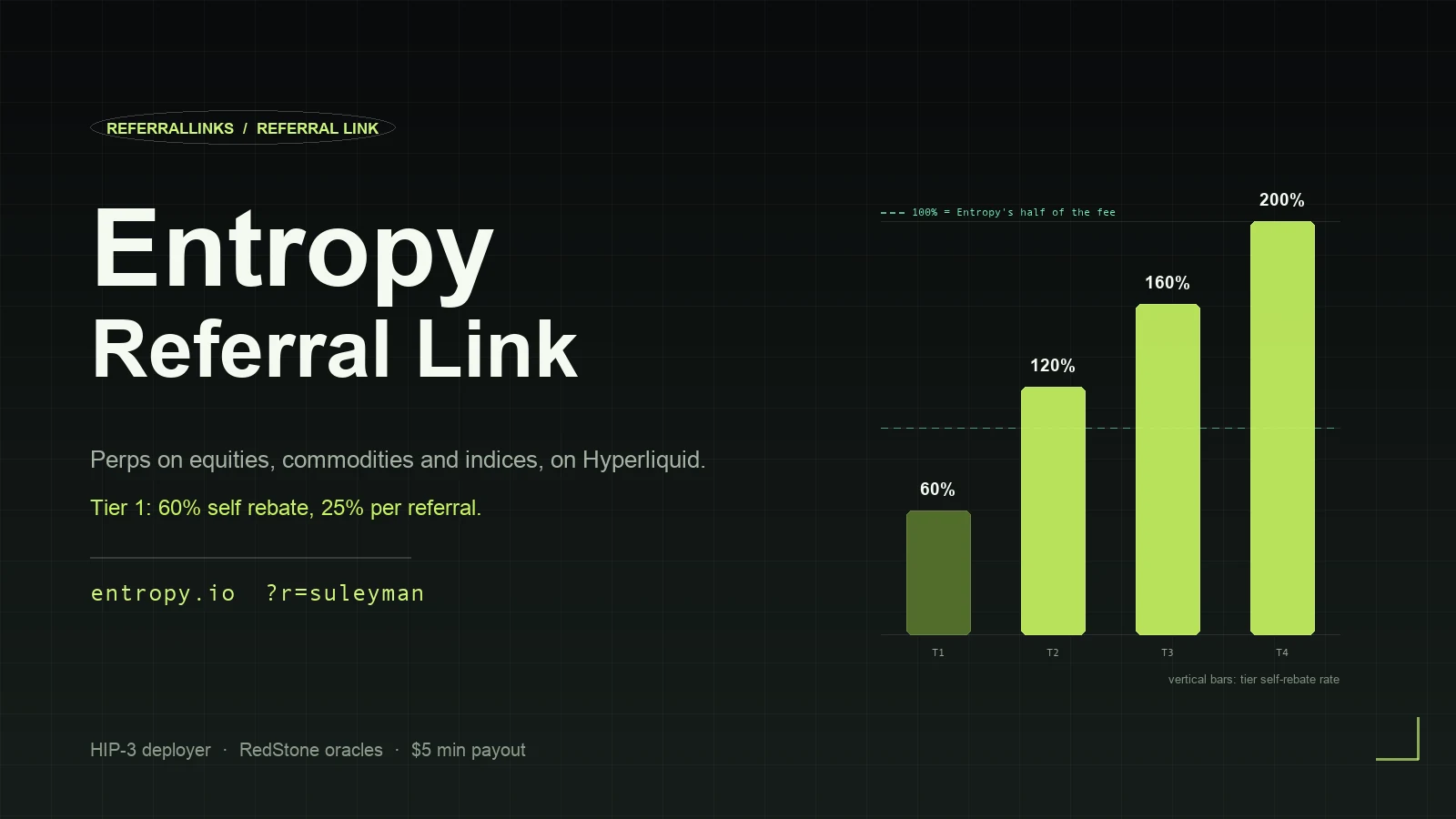
Entropy (entropy.io) is one of the deployers that operates its own perp markets on Hyperliquid. It lists perpetuals on global equities, commodities and indices, plus unusual products like long-dated pre-IPO equities, and prices them from RedStone oracle feeds.
Its referral program publishes real numbers, and those numbers come with two caveats that decide whether they mean anything: the percentages apply to Entropy’s slice of the trading fee rather than the whole fee, and the service is unavailable in a long list of countries.
You can compare it with every other deal on our crypto referral codes page.
The fine print
This link carries the ReferralLinks referral. A user who signs up through it gets a fee benefit, and you receive a referral reward on the fees their trades generate. Both figures are set by your tier. At Tier 1 that means 25% each. At Tier 4 it means 100% each.
What is Entropy, in plain words?
Hyperliquid is a purpose-built chain for on-chain markets. HIP-3, Hyperliquid Improvement Proposal 3, lets independent deployers permissionlessly run their own markets on top of it. Entropy is one such deployer: it operates the markets, sets their parameters and maintains the oracle feeds through RedStone.
The docs list the deployer address as 0xd5d18d…52ea and the oracle updater as 0x94757f…eDd5, with the ticker io.
In practice, that matters because trading on an Entropy market is not the same as trading on Hyperliquid's own order books: the fee is split between the two, and the referral math follows that split.
Why the referral base matters more than the headline number
This is the one thing worth understanding before you read any Entropy percentage. The docs give the worked example themselves: a trader generates $100 in total fees, roughly $50 goes to Hyperliquid and $50 to Entropy. Entropy’s rebate and referral percentages apply only to its $50.
So a 50% referral reward is $25, not $50. A 100% reward is $50, not $100. The percentages look larger than they are because the base is smaller than the number people have in mind.
Once that is straight, the tiers are easy to read:
| Tier | Threshold | Self rebate | Referral reward | Referred-user benefit |
|---|---|---|---|---|
| 1 · Trader | None | 60% | 25% | 25% |
| 2 · OG | None | 120% | 50% | 50% |
| 3 · Preferred | $10M rolling 30-day volume | 160% | 75% | 75% |
| 4 · Partner | $50M rolling 30-day volume | 200% | 100% | 100% |
Percentages apply to Entropy’s share of the HIP-3 trading fee, which the docs put at roughly half of the total fee.
Three benefits, and the non-stacking rule
Entropy splits the program into three things that are easy to confuse. A self rebate is a rebate on the fees your own account generates, and it rises with your tier. A referral reward is paid to you when somebody who joined through your link generates fees.
A referred-user benefit is the automatic fee benefit given to the person who signed up through your link.
The non-stacking policy is the part people miss: self rebate and referred-user benefit never combine on the same trade. If an account qualifies for both, it receives whichever rate is higher. Referral rewards are separate and keep being paid on top of your own tier benefits.
A concrete example, using the table above:
- Start at Tier 1. Every new account begins there, where the self rebate is 60%.
- Arrive through a Tier 1 code. The referred-user benefit on offer is 25%.
- Apply the non-stacking rule. The account keeps the 60% self rebate and ignores the 25%, because only the higher rate applies.
- Compare the result. On the published numbers the code adds nothing to that account’s own fees. At Tier 2 the gap widens: 120% self rebate against a 50% referred-user benefit.
That is worth stating plainly, because most referral pages imply the opposite. Read as published, the code’s benefit flows to the person who shared it, as a 25% referral reward on the fees the new account generates, while the new account trades on the standing tier rebate it would have had anyway.
If you are the one signing up, do not count on an extra discount; if you are the one sharing, the reward is real. Check Entropy’s current documentation before relying on either, since the tier table is the part most likely to be revised.
Rebates above 100% are a subsidy, not a business model
Tier 2 already rebates 120% of Entropy’s fee share, and Tier 4 rebates 200%. Above 100%, the program pays out more than the fee Entropy keeps from that trade. That is only sustainable as growth spending, and the docs label the whole table an "early bird period".
Read it as temporary by design. Percentages, thresholds and even the existence of the tiers can change, and the docs say trading activity during higher reward periods keeps that period’s benefits, which implies the periods end. Do not model next year’s income on an early-bird rate.
Who cannot use this at all
Entropy restricts a long list of jurisdictions, and the list is revised. At the last check it covered the United States and its territories, Canada, Cuba, Venezuela, the United Kingdom, Russia, Ukraine, Australia, Iran, Myanmar, North Korea, Singapore, Syria and most of the EU and EEA.
The authoritative version is on Entropy’s own site: read it there rather than from a copy, because a list reproduced in a guide is out of date the moment it changes.
If you are resident, a citizen, or an entity established or operating from a restricted place, the service is not available to you, and a referral link does not change that. This is not boilerplate: reading the current list first saves you from funding an account you cannot legally use.
Claiming rewards
Rewards are claimable from your Entropy profile page, with a $5 minimum to withdraw, and distributions run bi-weekly. That $5 floor is a real constraint at Tier 1: at roughly 25% of Entropy’s half of the fee, you need a decent amount of volume before the balance is even claimable.
All rewards are subject to review. The docs name wash trading, pre-arranged trading, self-referral and other inauthentic behavior as grounds for losing pending and future rewards, with eligibility at Entropy’s sole discretion. Farming a referral link with your own wallets is the fastest way to end up with nothing.
Frontends, accounts and the one rule that binds them
You do not have to trade on entropy.io to earn. The docs allow any frontend, including app.hyperliquid.xyz, as long as the trading address previously connected to Entropy and created an account, and the activity is on Entropy-deployed markets.
That is convenient, and it makes the account the thing that matters rather than the site you use.
It also means a trade on a Hyperliquid-native market earns nothing under this program, however it looks in the UI. Check that the market you are trading is an Entropy deployment before you count on a rebate.
How to start
Open the link on this page, or type entropy.io into the address bar and confirm the ref parameter reads r=suleyman, then connect a wallet and create the account. Confirm you are outside the restricted jurisdictions first.
Place one small trade on an Entropy-deployed market, then check your profile page to see the rebate and any referral credit accruing before you scale up.
Treat the first week as a test of the plumbing, not of the strategy: confirm the fee split you actually see, confirm the reward appears where the docs say it will, and only then decide whether the tier matters to you.
Frequently asked questions
What is the Entropy referral code?
The ReferralLinks code is suleyman, built into the sign-up button on this page. A user who signs up through it receives a referred-user benefit and the referrer earns a referral reward.
How much do I earn per referral?
25% at Tier 1, 50% at Tier 2, 75% at Tier 3 and 100% at Tier 4, but each percentage is of Entropy’s share of the HIP-3 trading fee, roughly half of the total. So Tier 1 earns about 12.5% of the total fee a referral generates.
Do the self rebate and the referral benefit stack?
No. On the same trade an account receives either its tier self rebate or its referred-user benefit, whichever is higher, never both. Referral rewards earned on other people’s trades are paid separately and do not affect this.
When can I withdraw rewards?
From your Entropy profile page, with a $5 minimum, on a bi-weekly distribution schedule. All rewards are subject to review, and inauthentic trading can void them.
Is Entropy available in my country?
Not everywhere. Entropy restricts a long and changing list of jurisdictions that includes the United States and its territories, Canada, the United Kingdom, most of the EU and EEA, Russia, Ukraine, Australia, Singapore and Syria. Because the list is revised, check the current version on Entropy’s own site before signing up.
Before you commit
These answers do not depend on the current rate, so they stay true when the numbers above them move.
How to check that the Entropy code actually applied
Check on the platform, not on a code list. Open entropy.io from its own domain, start the sign-up (or the first deposit) and read the confirmation screen before you approve anything.
A referral that registered shows up as one of three things: a reduced fee in the order preview, a rebate line in the account, or a visible referral tag next to your address.
If none of the three is there, stop and reopen the link from this page instead of signing up and looking for a code field afterwards.
Almost every program in this list attaches the referral at registration only; a code typed later, or a page refreshed later, cannot retroactively claim an account that was created without one. This site re-tests each flow by hand and prints the date in the sidebar.
How we test codes describes what that involves.
What happens if the Entropy program changes or ends
Two different things end at two different times. The terms you signed up under usually keep applying to your account while the program runs, and the platform can change those terms with notice, so a rate you earned last month is not a rate you are owed next month.
When a program ends, the code field stops accepting new codes and new sign-ups stop being attributed; existing balances revert to the standard rate on the platform’s own schedule.
Commission already credited is the platform’s obligation to the person who referred you, not something this site can recover or guarantee. If a page here is out of date, it is because the change has not been re-checked yet, not because the number was invented: every figure carries the date it was last confirmed.