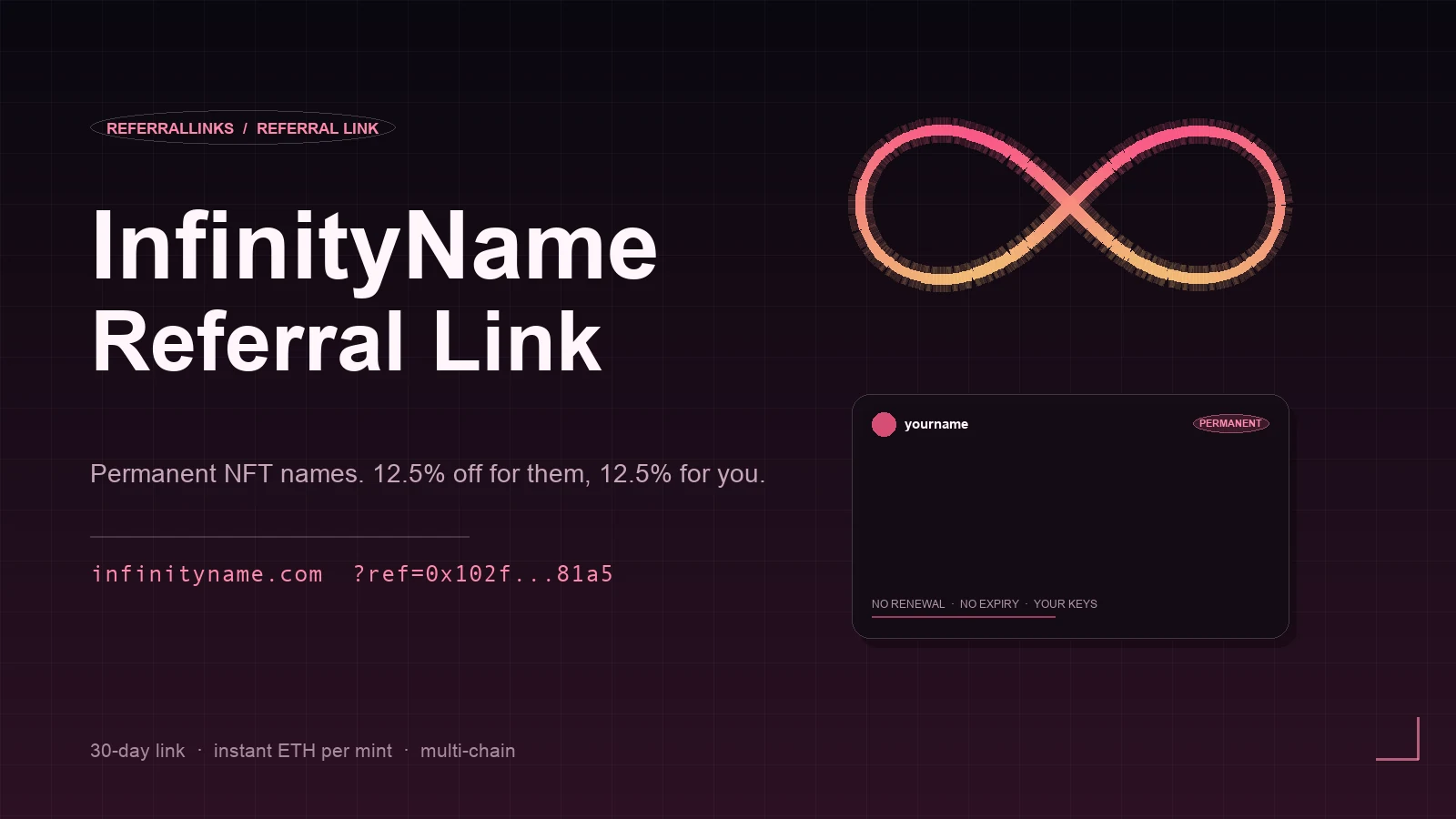
InfinityName (infinityname.com) is a name service that sells permanent NFT domains: one payment, no renewals, no expiry, and the name lives in your wallet as a token. Its referral program is unusually generous on paper, giving both sides 12.5%.
This guide checks the arithmetic, separates what the marketing promises from what the product actually does, and explains the one detail most referral pages skip: how little 12.5% is when a mint costs 0.00032 ETH. You can compare it with every other deal on our crypto referral codes page.
The fine print
This link carries the ReferralLinks referral. Both sides get 12.5%, which is unusual: most programs pay the referrer and leave the friend paying full price.
| Item | Terms |
|---|---|
| Your friend saves | 12.5% off the mint price |
| You earn | 12.5% of the mint price |
| Payout | Instant, in ETH, straight to your wallet with no claim step |
| Example commission | 0.00004 ETH on a 0.00032 ETH mint |
| Attribution window | 30 days after the first click |
Commission and mint figures use the average mint price in InfinityName’s own example (0.00032 ETH on Soneium).
At the average mint price the site uses in its own example, 0.00032 ETH on Soneium, your commission is 0.00004 ETH per mint. That number is the whole story of this program, and the rest of this page is about what it means.
What is InfinityName, in plain words?
A traditional domain is rented from a registrar. You pay every year, the registrar is the source of truth, and the name lapses if a renewal is missed. InfinityName takes the opposite position: the name is an NFT on a blockchain, you hold the keys, and there is no annual bill.
Its manifesto is explicit about the target, describing renewal fees, premium increases and expiry as extraction, and arguing that ownership should be enforced by contracts rather than by a support ticket.
The product claims are consistent with that pitch: permanent ownership, no renewal, on-chain resolution, multi-chain support, and censorship resistance as far as the underlying chain provides it. Whether a given name is usable as a website address depends on wallets and browsers supporting that name service, which is a different question from owning the token.
The site acknowledges this, saying records can point to content and that the name can bridge Web2 and Web3 as tooling evolves.
The arithmetic, checked
InfinityName ships an earnings estimator. Set it to 4 friends, 3 mints each and the default 0.00032 ETH mint price, and it reports 12 total mints, 0.00048 ETH earned and 0.00048 ETH saved by your friends. The math behind that is straightforward:
12 mints times 0.00032 ETH is 0.00384 ETH of mint volume. 12.5% of that is 0.00048 ETH. Per mint, your share is 0.00004 ETH.
So both sides of the 12.5% land on the same figure in this example, which is a neat coincidence of the estimator rather than a rule. Your commission scales with how many mints your referrals make, not with how expensive a single name is, unless the price changes.
What 12.5% of a mint actually pays
Permanent domains are a one-time purchase, and most people buy one name and stop. That makes the referral economics fundamentally different from a trading fee, which recurs every time somebody trades. Your upside is a share of first purchases, not a share of ongoing activity.
A realistic pattern looks like this: a friend buys one name for roughly 0.0003 ETH, you earn about 0.00004 ETH, and that relationship is finished. To reach the estimator's 0.00048 ETH you need twelve separate mints from people you referred.
Compare that with a fee-discount program where one active trader generates commission every week, and the difference is obvious.
The site also describes the 12.5% as a lifetime commission rate. Read that as the rate never decaying, not as an income stream for life: there is no recurring charge on a permanent name for a commission to attach to.
The 30-day window versus lifetime wording
Two statements on the same page deserve to be read together. One says the link is valid for 30 days after the first click. The other calls 12.5% a lifetime commission rate.
The reconciliation that fits both is that attribution has a 30-day window while the rate itself does not shrink over time. That is the common design, and it is also the reading that stops you from expecting commission on a purchase made two months after a click.
If the exact mechanics matter to you, confirm them in the app before you plan around them; a marketing page is not a contract.
Payouts, gas and small amounts
Commission is paid in ETH and described as instant, on every successful mint. Instant is the right word for settlement, and it raises a practical question about size: an on-chain transfer has a gas cost, and the payout is roughly 0.00004 ETH.
Whatever mechanism the platform uses to send it, a reward that small is at the edge of what is worth moving on a busy network.
That does not make the program dishonest; it makes it small. If you refer a handful of people you will see a handful of dust-sized credits, and consolidating them later may cost more than they are worth on an expensive chain. Treat referral income here as a rounding error, not a strategy.
Multi-chain claims and the Soneium default
The estimator labels its mint price as 0.00032 ETH per Soneium, and the marketing copy says all blockchain networks are supported. Both can be true at once, but they are not the same claim: the price you see is not universal, and the fee, gas and payout mechanics can differ per chain.
So do not generalize the 0.00032 ETH figure to every network, and do not assume your friend’s purchase on one chain pays out on the same one. Check the price your friend will actually pay before you promise them a saving.
What a permanent name does and does not give you
Buying an NFT name gets you a token you control. It does not automatically get you resolution in every wallet, a browser address bar entry, or the legal certainty of a registered trademark. Those are separate problems, and no name service solves them by itself.
It also does not remove the risks that come with holding keys. Lose the wallet and the name is gone with it, and there is no registrar to appeal to, which is the same property that makes seizure by a third party difficult. Permanence cuts in both directions.
How to claim the 12.5%
Open the link on this page, or type infinityname.com into the address bar and confirm the ref parameter is the address above, character by character. A referral link is a wallet address here, so a single altered character sends your friend’s attribution somewhere else.
Connect a wallet, search for a name and check the price at checkout; the discounted figure should already be showing if the referral registered.
If you mint without a referral, there is no way to attach one retroactively. Attribution is a property of the visit.
Frequently asked questions
What is the InfinityName referral code?
The ReferralLinks code is the address 0x102f47…81a5, built into the sign-up button on this page. Your friend saves 12.5% on a mint and you earn 12.5% of it.
How much do I earn per mint?
12.5% of the mint price. At the 0.00032 ETH figure InfinityName uses in its own estimator, that is 0.00004 ETH per mint. Twelve mints would earn about 0.00048 ETH.
How long does the referral link work?
InfinityName says the link is valid for 30 days after the first click, and separately describes the 12.5% as a lifetime commission rate. The consistent reading is that attribution has a 30-day window while the rate does not shrink. Confirm the details in the app if it matters.
When are rewards paid?
Instant and automatic, in ETH to your wallet, on every successful mint. There is no claim step described. Because each payout is small, watch the gas cost of moving it later.
Do InfinityName domains expire?
No. The product is a one-time payment for an NFT you hold, with no renewal and no expiry. That means losing the wallet also means losing the name, since there is no registrar to recover it from.
Before you commit
These answers do not depend on the current rate, so they stay true when the numbers above them move.
How to check that the InfinityName code actually applied
Check on the platform, not on a code list. Open infinityname.com from its own domain, start the sign-up (or the first deposit) and read the confirmation screen before you approve anything.
A referral that registered shows up as one of three things: a reduced fee in the order preview, a rebate line in the account, or a visible referral tag next to your address.
If none of the three is there, stop and reopen the link from this page instead of signing up and looking for a code field afterwards.
Almost every program in this list attaches the referral at registration only; a code typed later, or a page refreshed later, cannot retroactively claim an account that was created without one. This site re-tests each flow by hand and prints the date in the sidebar.
How we test codes describes what that involves.
What happens if the InfinityName program changes or ends
Two different things end at two different times. The terms you signed up under usually keep applying to your account while the program runs, and the platform can change those terms with notice, so a rate you earned last month is not a rate you are owed next month.
When a program ends, the code field stops accepting new codes and new sign-ups stop being attributed; existing balances revert to the standard rate on the platform’s own schedule.
Commission already credited is the platform’s obligation to the person who referred you, not something this site can recover or guarantee. If a page here is out of date, it is because the change has not been re-checked yet, not because the number was invented: every figure carries the date it was last confirmed.